
Coffee is Getting So Expensive, But at Least the Farmers are Finally Getting Paid. Right?
So have you been noticing that coffee is getting more expensive? Your daily cappy at your favorite cafe has gone up a buck? Your local grocery store is charging more for your go-to bag of beans? I guess that’s not too surprising, the cost of everything is on the rise and has been for some time (and we’ll come back to that), but you aren’t crazy, coffee has been getting more expensive more quickly. By some measures, specialty coffee retail prices have jumped by nearly 10% in just the second quarter of this year.¹
Sorry. I really do wish I could help you with that. But hey, look on the bright side! Higher coffee prices mean farmers are making more money, right? Inching ever closer to something resembling a living wage? Isn’t that how it works?
Ugh… this is awkward. Why don’t you sit down?
First, we have to talk about the twerps in Antwerp
If you are from Antwerp, I don’t mean you ;-)
For reasons that I still can’t get my head around, even after more than a decade working in the coffee industry, the price you pay for a cup of joe or a bag of beans seems to have more to do with a bunch of unremarkable coffee sitting in warehouses in Belgium than it does with the work of the actual coffee farmers.
I’m choosing not to try to explain the Intercontinental Exchange (ICE)², its warehouse system, or why we have all agreed to make it the Great and Powerful Oz of coffee pricing. In part because it’s boring. In part because the more I understand about ICE, the more it makes me angry. But this is the ballgame. The news reports a drought in Brazil, a bumper crop in Colombia, or floods in Vietnam and smartphone-wielding traders click onto digital exchanges to cosplay as coffee dealers, buying and selling contracts for beans they will never see, touch, or taste. The result is a volatile commodity seesaw that is ultimately the biggest factor in determining how much importers and roasters have to spend to bring you your favorite brew.
And guess what? That ICE price has been trending very high for a while now.
Right, so when the Exchange price is high, farmers should be getting paid more.
That would make sense, but it really isn’t that straightforward. ICE pricing is entirely based on green coffee trading, which is largely a process that involves tons of paperwork, cargo ship manifests, and a bunch of other stuff that makes the whole thing rather transparent. Moreover, there is significant equilibrium between exporters and importers and even roasters. Buyers of coffee have options if they don’t like the prices they are being quoted. And don’t forget that banks play a role here too. Their financing decisions are closely tied to the ICE price, creating another check against the green trade descending into chaos.
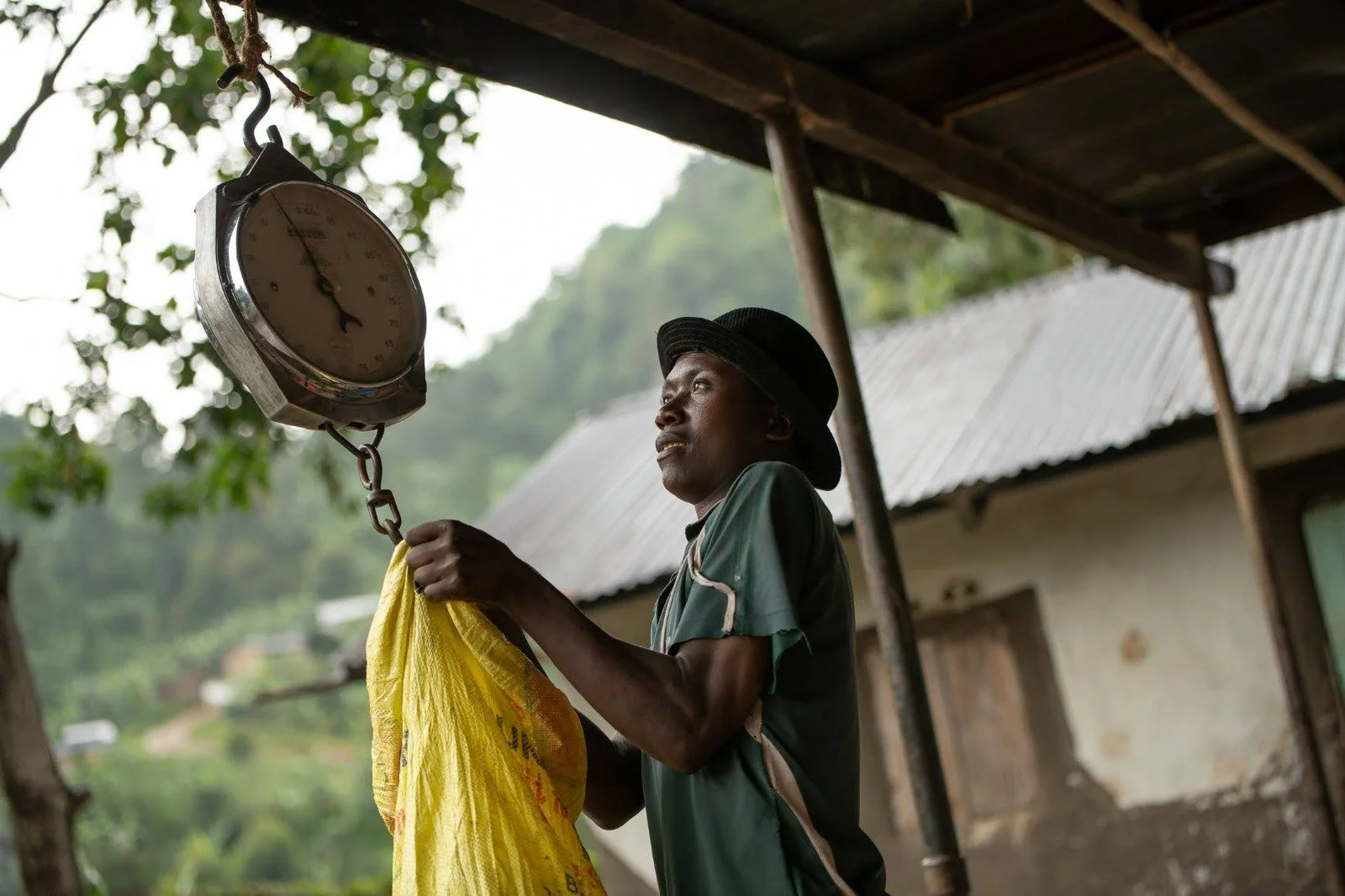
At the farm, however, these and other protections aren’t so common. For the most part, a smallholder farmer in Uganda (for example) isn’t selling green coffee but coffee cherries or maybe parchment.³ Often the farmers are several layers removed from the exporter and sell through middlemen, collection and washing stations, mills, etc. And, unlike buyers, they rarely have options – the middleman is offering what he is offering and he’s offering it today. He may not come back and the coffee farmer needs the money to buy food or pay for school fees that won’t wait.
In Uganda right now, coffee farmers are generally earning more for their coffee than they were a decade ago when Endiro first started directly buying from farmer groups. So, I’m not saying there is zero relationship between the Intercontinental Exchange and the coffee farmgate, but it is an uncertain one that is often lacking in transparency and vulnerable to abuse. Thousands of miles away there are people in offices or airport lounges or Ubers getting wealthy by trading “Coffee Futures”, while the futures of coffee farming families grow increasingly less secure.
You see, coffee isn’t the only thing that’s more expensive.
I told you we’d come back to this, and this really is the rub. Even if a coffee farmer is getting paid more now for their coffee than they were a few years ago, that doesn’t mean that they are doing better overall. Just like you are paying more for rent and groceries and fuel and utilities, so are they. In particular, many coffee farmers rely on inputs like fertilizers and pesticides that are getting more and more expensive. Many use gas-powered equipment or transport and are facing the same skyrocketing⁴ fuel prices as the rest of us. Food costs more. Labor costs more. Everything seems to cost more.
We need to be asking not just how much farmers are getting paid, but how much of a profit are they actually realizing? Even in this era of expensive coffee, many farmers are producing coffee at a loss.⁵
And then there is the question of long-term sustainability.
When all coffee is expensive, the incentives for producing specialty coffee weaken.
This is probably a topic we need to dig into deeper at another time. For now, let me just make this point: when the price of commodity coffee increases, the price of specialty coffees does not increase at the same rate. Furthermore, mandatory premiums for “Certified Organic” or “Fairtrade” are fixed and do not proportionally increase alongside the ICE price.⁶ What this means is that when the global price of coffee goes up, the value difference between a low-quality gas station coffee bean and a great specialty coffee narrows.
So, say you're a specialty coffee roaster who has been in relationship with a group of farmers for years and have worked together with them to develop an award-winning specialty coffee. That coffee isn’t easy to produce. It demands the best practices in pruning and harvesting; disciplined processes of fermentation and pulping and drying; a commitment to regenerative agricultural practices so that farms and forests get healthier and produce value for generations to come. But now the farmers in the next village who don’t do any of that are getting paid almost as much for a lot less work. Without this financial motivation, it is understandable that many farmers abandon specialty coffee production. Unfortunately, this also means drifting away from the very sustainability strategies and direct trade relationships that can offer them an alternative to the inherent caprice of the ICE-based system.
So, does it really even matter what coffee you buy?
It does. Elsewhere, I have quoted this from Karl Wienhold:
“If something is cheaper than it’s worth, either someone else is subsidizing it, or someone is getting a raw deal . . . If you like cheap coffee and don’t care if it’s bad, or if it is half-burned rice and chickpeas, then have at it. But if coffee is both good and cheap, it’s probably because a producer was swindled.”⁷
As a general rule cheaper coffee is not being produced in a way that is sustainable for either the farmer or the growing areas. I’d encourage you to avoid dirt cheap coffees for that reason. However, I would not therefore assume that expensive coffee is necessarily making life better for farmers and their families.
You need to look deeper.
Certifications are a solid starting point. Popular ones like Fairtrade, Organic, or Rainforest Alliance are all doing some important work to confirm certain kinds of good labor or environmental practices. B Corp goes further to provide more comprehensive third-party reviews of companies and their practices (for an example, here is Endiro’s B Corp report card).
I would encourage you though to ask for more than simply a badge on a bag of beans. None of these programs are perfect and all can be and are gamed. I suggest looking for stories.
Yeah, people can make up a story, but I’d argue that it’s harder.⁸ A coffee roasting company can say they believe in “Relationship Coffee”, but they should also be able to tell you about those relationships. And the stories they tell need to be stories of collaboration, reciprocity, mutuality between producers and roasters. What do their stories tell you about long-term impacts, sustainability, and regenerative practices in agroforestry systems? How many stories do they have to tell? Who is telling the stories? How real are the stories? How old are they?
Even as I write the above, I deeply feel the many ways that my own company has fallen short. I reckon we all need a lot more stories.
I suppose I’m asking a lot and you just wanted a cup of coffee. But you didn’t have to read this far – that’s on you. So here we are in the final paragraph together – facing a world of coffee that is too expensive and too unjust. Unfortunately, there are no easy fixes here, but unlike our coffee farming friends, we have choices. There are ways we can begin to be part of a solution rather than part of the problem.
_________________
1. “Specialty Coffee Retail Transaction Index” https://www.transactionguide.coffee/reports/2026q2
2. “Coffee traders' big shipments are set to boost exchange stocks and weigh on prices“ https://www.reuters.com/business/coffee-traders-big-shipments-are-set-boost-exchange-stocks-weigh-prices-2026-09-11/
3. “What is Coffee Parchment?” https://www.nordicapproach.no/glossary/coffee-parchment
4. “Skyrocketing fuel prices spark protests around the globe” https://www.cnn.com/2026/09/15/world/fuel-prices-protests-iran-war-intl
5. The report “Making Markets Work” is helpful in showing that many farmers don’t even realize that their costs for producing coffee are often higher than their revenues. The report also begins to illustrate how a Participatory Market Chain Approach is helping some coffee farmers capture more value. https://sca.coffee/sca-news/25/issue-25-insight-making-markets-work-l5e9c
6. “Fairtrade Minimum Price for Coffee” https://www.fairtrade.net/content/dam/fairtrade/fairtrade-international/standards/standards-and-pricing-work-in-progress/coffee-price-review/Fairtrade%20coffee%20price%20update%202026-FAQ.pdf
7. Karl Wienhold, 2021. Cheap Coffee: Behind the Curtain of the Global Coffee Trade.
8. I’m getting an argument from the peanut gallery that goes like this: “You wanna bet?” I hear you. You may be right. People are lying liars. But what I’m saying is that stories are harder. Humans have a decent ear for baloney and if you find a coffee company that has both stories and badges, well I think that’s something. I also just have been doing this long enough to have seen all the ways that I could lie about our coffee business to make it more marketable. And I am growing to believe more and more that if we just tell more stories and let everyone in our tree-to-cup journey tell more stories – well, then it all just gets more difficult to fake.