
The Robots are Coming for Your Coffee: AI, Automation & the Future of Cafés
What the PUQ is that?
The first time my daughter encountered one of those PUQ automated espresso tampers she rolled her eyes so hard I thought about calling Father Karras. But, I think he died at the end of that film, right?
She’s my favorite barista – my daughter, and she’s a purist. She believes in the craft and eschews technological innovation. A true Gen Zer with the heart of a Boomer shaking her fist at progress and pontificating about “back in my day”!
I mean, I know where she got it. I introduced my kids to specialty coffee and pour overs using only cloth filters and cold brew ground only on my century-old Hobart. And, try me bro, I could tamp out exactly 30 pounds any time, any place. Probably.
But, I kinda liked the PUQ.
We were in this cafe on temporary assignment to help launch the new coffee shop. The owner, experienced in the hospitality industry but not in coffee per se, had purchased a suite of equipment that represented the cutting edge of cafe technology and automation. For him, it was practical. He was planning for efficiency and consistency. Ironically, he was actually a Boomer, but was embracing innovation and progress – it would make the business easier to run.
I’m the X’er in the middle. I love the analog preferences, if not always consistent, of my daughter. But I’ve run cafes. I know how tight the margins are. I know how hard consistency is. I know what it feels like to need any small advantage you can get.
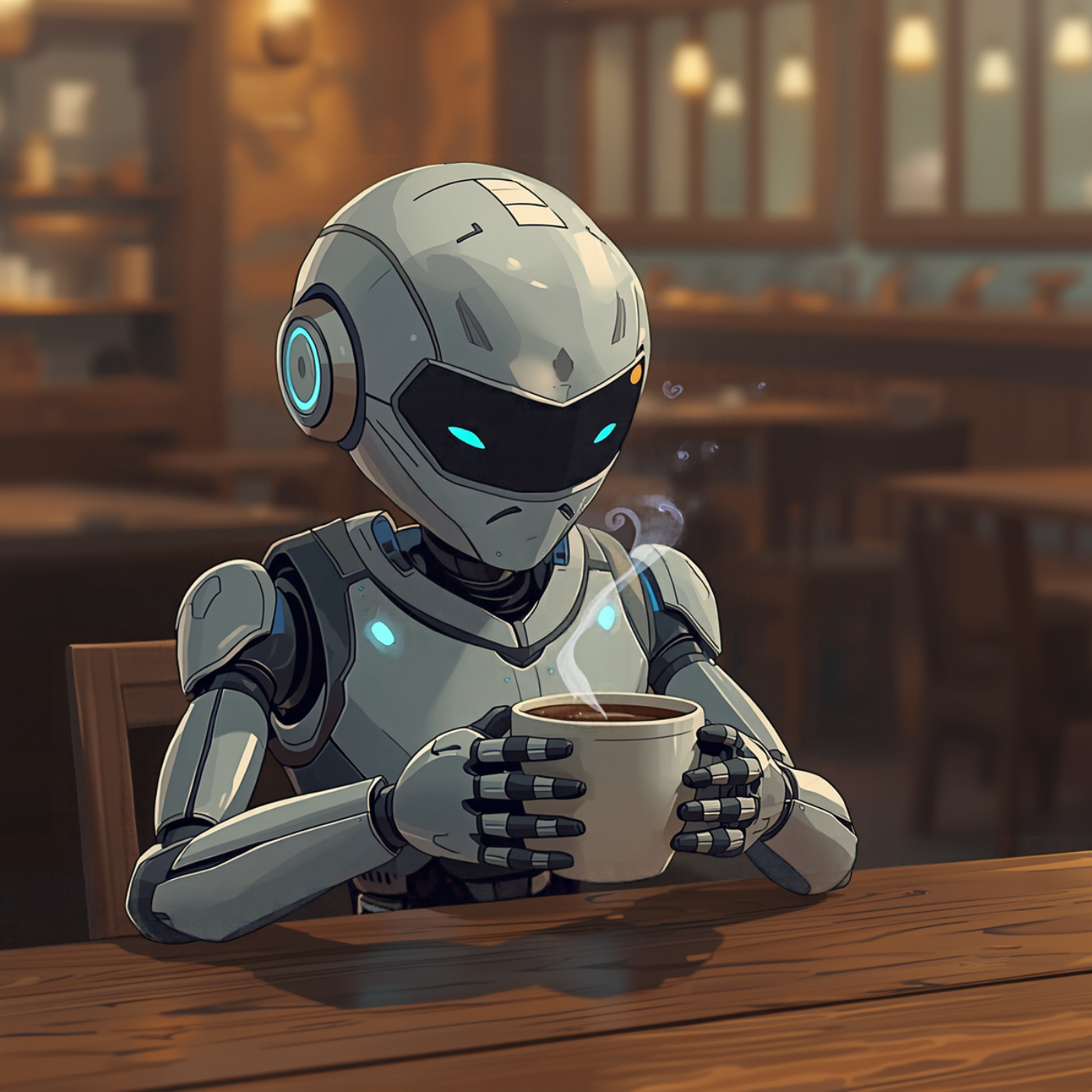
So are the Robots Coming for Your Barista?
This essay is destined to be the beginning of a series with which we will take our sweet time. Over the next year, I want to look at technology, automation, and especially artificial intelligence and how it’s impacting the coffee industry for good or ill. And I want to begin at the cafe, where so many of us began our coffee journeys with our first PSL or our first job.
Allow me to recap something of the past decade. Back in 2017, we (Endiro) built out an impossibly cute and dangerously cool cafe in the Chicagoland area. It was the word made brick and mortar for my “third space” ideals and quickly became a gathering place for all kinds of folks. There were the business meetings and the first dates, Bible studies and pyramid schemes. We had parties and concerts and town halls. We eventually even became a sort of required stop on all state-wide political campaigns – those not-at-all-contrived meet and greets designed to make politicians seem like regular people. It was all kind of fun. Maybe you’ve had a similar experience.
And then COVID shut us all down. It felt like a shift started from the pandemic, away from space creation and towards drive-thrus and take away counters and then the technology to support a contactless lifestyle. The masked and six-feet-apart era replaced our gathering spaces with app-based ordering and Doordashed cappuccinos. And long after we’ve ditched our N95s the technology has continued to remove the humans (and the humanity) from our morning coffee routines. Now I regularly see touchscreens at the counter instead of a teenager who remembers my “usual”. At least once a week, I’m yelling rather profanely at the AI bot that now controls the drive-thru at my breakfast spot.
There is an argument that goes like this: “The automation and AI allow us to have our employees focus more on hospitality.”
This is fleshed out well in a recent article over at Perfect Daily Grind and I won’t recount it here. I get the idea. If your barista doesn’t need to take your order or tamp your espresso or steam your milk, then they are free to chat you up and make you feel at home. I mean, I think that’s the gist.
I’ll take you back to that AI drive-thru. By the time the bot has agreed that I don’t want to round up to support their charity (sorry, I’m just here for the sausage egg cheese) and I roll around to the window with steam pouring out of my ears, I should, by the above reasoning, be expecting a warm greeting, maybe even a smile. Instead, I don’t even get eye contact. Just a place to tap my card and a bag of food.
I took my son for cheeseburgers at a new place this week. It had the touchscreen ordering system. It took us a minute but we figured it out and got our order placed and paid for. The dude behind us was not as fortunate and gave up on the screen. He stood at the counter POS and waited for a human to help him – none came. He yelled for help, crickets. Eventually he stormed out, a scene that would have been more dramatic if he hadn’t tried to push open a pull-to-open door – but we’ve all been there.
These are just anecdotes and not true research. But, to me, it seems like the tech, the AI, the automation just encourages human distance – even a kind of dehumanization, rather than freeing up employees to get better at hospitality.
Another argument that is raised in that PDG article is that automation and AI mostly just take over repetitive, mindless work. The boring stuff. Like tamping, I guess. Or like taking an order. It is argued that this can reduce repetitive stress injuries. That’s good, I suppose. My old tamping injury really messes with my pickleball game.
In all seriousness, I’m not sure I can get behind this argument either. This is going to sound a little “back in my day”, but is repetitive work really all that bad? Didn’t Gladwell have a point with the whole 10,000-hour argument? Am I the only one who sometimes finds repetitive work satisfying? Not all of it perhaps. But getting something right – like a roast profile or a pour over – over and over and over again. It’s kind of awesome, and it probably builds a little character.
But the Robots are Still Coming.
There is a certain inevitability here. And the outright rejection of technological progress can feel a little bit like the horse and buggy driver flipping off a passing automobile. And cafe owners get worried about falling behind, not because of some high-tech FOMO but because this business is hard and the margins get thinner and thinner. As much as many of us want to create as many jobs as possible, show us a machine that saves us 10% on labor cost and we are your reluctant huckleberry.
Millions of jobs in hospitality are going to be replaced and nearly all of them are going to be transformed by AI and automation over the next several years.
The International Labour Organization tried to mollify our fears by arguing that mostly AI is going to transform our jobs rather than replace them.
“As most occupations consist of tasks that require human input, transformation of jobs is the most likely impact of GenAI. Such a transformation is best managed through social dialogue.”
I'm just going to ignore for now the extreme heavy lifting that the phrase “social dialogue” is doing here and focus on this. The report from which this conclusion was drawn was published in 2025 based on data from 2024. Have you been paying attention to how quickly AI has been evolving? In a recent episode of The Daily, mathematician Steven Strogatz described the growth of AI’s math skills from that of a good graduate student in about May 2026 to having solved one of the unsolved Millennium Prize Problems a couple months later – something the human mathematicians spent a quarter of a century trying and failing to do. To quote Matt Damon, “How do ya like dem apples?” I just don’t think we can simply take it as a given that “most occupations” will continue to need human input.
At the basic level, even the PDG article agrees that AI and automation are going to gradually eliminate low-skilled jobs. The contributing thinkers in that article are not celebrating this, they are just accepting it and trying to look at the opportunity to invest more in barista skilling.
I’m going to quote Michael Phillips (formerly of Blue Bottle) directly from that PDG article:
“The skills that get sought after, and paid for, are the ones the equipment can’t hold: the ability to connect with guests, to build community, to generate real excitement for the product, and to teach. Those have always been the rarest skills behind any bar, and they’re about to account for the majority of work.”
Phillips is making the case that if the improved margins realized through technological advancements, AI, and automation are reinvested in better pay and training for baristas who are then “given an actual career path,” then it will be a good thing.
I agree that is good. Though I’m not convinced it is good in the final balance. A real barista career path is amazing and a dream many of us have had. But, for me, that dream begins with a young person landing their first part-time job. Over 15 years of Endiro lore, we’ve been a first job for so many young people. Some of those stories have become long coffee journeys for people who went on to manage coffee shops or become coffee roasters or Q-graders, or coffee farming experts. For others, we were just a weigh station. We were a place of employment for someone who needed to pay for tuition, a job to give someone a chance to stabilize their life or get out of a difficult situation. People learned a little about leadership, teamwork, craft, hospitality, working hard, and tamping a consistent 30 pounds. And then they moved on to the next chapter. And that’s all really, really good.
See, I get emotional writing that. I want to look optimistically at what is happening with technology these days, but if you tell me it means I won’t ever be able to create those kinds of jobs, those kinds of teams, well, give me back my horse and buggy.
It’s Not All Robots Though.
In the past couple years, something unexpected has happened in the United States. There is this weird and hard to explain surge of Yemeni coffee shops happening all over the country. A few years ago there were like just a few of these cafes and they were mostly located in Yemeni or at least Arab diaspora communities. Now there are several chains and we are quickly getting to 150 total cafes. It’s freaking crazy.
And do you know what they are doing? They are creating space again. They are mostly ditching the drive-thrus in favor of dining rooms and comfy seating and beautiful decor. My favorite spot has a meeting room you can reserve. The shops have long hours – my kids hang with their friends there late at night. It’s the kind of place where you want to read a book or write an overly long blog post.
I find this spectacularly interesting and hopeful. The experiment of an all AI-powered cafe in Stockholm failed and a human-centered old-school third-place experiment is thriving. I even hear that Starbucks is shifting back to this space creation approach. From their website: “We are refocusing on … a welcoming coffeehouse where people gather, and where we serve the finest coffee, handcrafted by our skilled baristas.”
Hehe… my daughter could have written that.
What I’m doing right now, as a coffee professional, is watching this space closely. I understand the appeal of technology, automation, and even AI. It has the power to make it easier to keep our businesses running, operating, open. That’s a big one – it gets to our gut and to how we keep our coffee shop dream alive. If there are tools that can help us, we want to know about them. We want to use them.
But, on the other hand, if these tools erode our humanity and suck the soul out of our spaces – well, is this still the dream we had at the beginning?